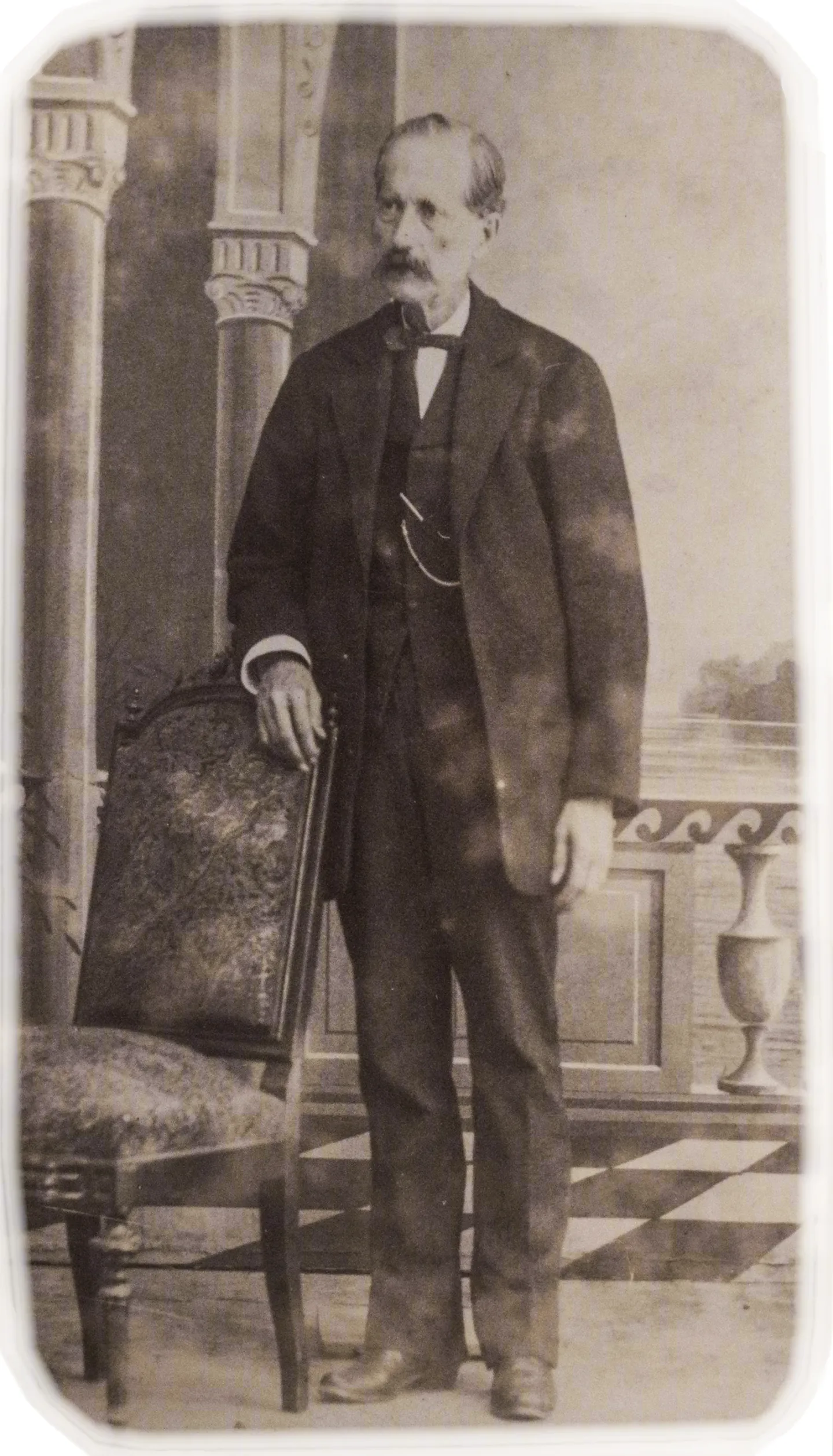
He was born in La Cañada de San Urbano in 1817 and died there on November 19, 1892. His guitars, made in Seville and in Almería, changed the construction of the instrument. The city has dedicated a museum to him since 2013.
AlmeríaYa newsroom
·
Photo: Autor desconocido (fotografía de 1884, Barcelona). Subida a desde una colección privada / Wikimedia Commons (Dominio público (PD-Spain-photo; PD-US-expired))
The secret of his guitars, Antonio de Torres used to say, would go with him to the grave. The priest Juan Martínez Sirvent, who knew him in his last years in La Cañada de San Urbano, told the story. According to his account, the guitar maker explained that it was all in the touch of the tips of the thumb and index finger, which told him whether the top was well worked.
Torres was born in La Cañada on June 13, 1817 and died there on November 19, 1892, at four in the afternoon. The English Wikipedia describes him as the most important Spanish guitar maker of the 19th century. Julián Arcas, Francisco Tárrega, Miguel Llobet and Emilio Pujol played his instruments, and today concert performers such as Carles Trepat and Stefano Grondona do so.
Some dates saved from the war
The dates of his life have their own story. The baptism and death records were in the parish of San Sebastián de La Cañada and were destroyed in the bombings of the Civil War, according to the documentation work by María del Mar Poyatos Andújar for the Universidad Internacional de Andalucía (2014).
They are known because in February 1931 the canon archivist Francisco Rodríguez Torres published the book and the folio of each one in the Almería newspaper La Independencia. The guitarist Domingo Prat also transcribed the copies certified by the parish priest in a dictionary published in Buenos Aires in 1934. The guitar maker's family then gave other dates, 1820 and February 1893, which turned out to be wrong.
From Vera to Seville
According to the English Wikipedia, he began as a carpenter's apprentice at the age of 12. He lived in Vera, where he married for the first time. When his wife died, in 1845, he left his only daughter with her grandparents and went away. Poyatos considers it likely that he learned the trade with the guitar maker José Pernas in Granada, although little is known about those years.
In January 1853 he appears advertised in the Seville newspaper El Porvenir as a guitar maker. He settled in Ballestilla and Cerrajería streets, where other guitar makers worked. In Seville he met the Almería guitarist Julián Arcas, who gave him fame, and a young Francisco Tárrega would buy three guitars from him over the course of his career. In 1858 he was awarded a prize at the Exposición Agrícola, Industrial y Artística de Sevilla for a guitar with a tornavoz. It is his "first period", that of "La Leona", one of his most famous guitars.
According to the English Wikipedia, Torres made the tops thinner and lighter, arched in both directions, with a symmetrical system of fan struts, and he enlarged the body. In 1862 he built a guitar with papier-mâché sides and back to show that the sound comes from the top; it is kept in the Museu de la Música de Barcelona.
Specialists qualify his role. Poyatos recalls that the musicologist Thomas F. Heck, in the New Grove dictionary, presents Torres as someone who perfected construction elements that already existed, not as their inventor.
The crockery shop and the second period
In 1868 he married Josefa Martín, with Julián Arcas as best man. Around 1870 he returned to Almería with his family and opened a crockery and glass shop at calle Real, number 23. He left guitars aside for a time and took them up again in what is known as his "second period". His second wife died in 1883. Shortly afterwards he settled in La Cañada, and in 1884 and 1885 he travelled to Barcelona. The photograph that illustrates this news item was taken in that city in 1884.
Research into his life owes much to the luthier José Luis Romanillos, author of "Antonio de Torres: guitarrero, su vida y obra", published in 1987 and reissued by the Instituto de Estudios Almerienses.
Almería dedicates the Museo de la Guitarra Española Antonio de Torres to him, next to the Cathedral, inaugurated on December 20, 2013. Its inaugural exhibition included original guitars by the builder.
Share this story
Breaking news from News, on your phone
An alert only when something can't wait. Free, no account needed.
On iPhone, alerts only arrive if you first add AlmeríaYa to your Home Screen.
How to do it, step by step
This browser can't receive alerts. Try another one, such as Chrome or Safari.
You've blocked alerts from AlmeríaYa in this browser. You can turn them back on in its settings.
How to do it, step by step