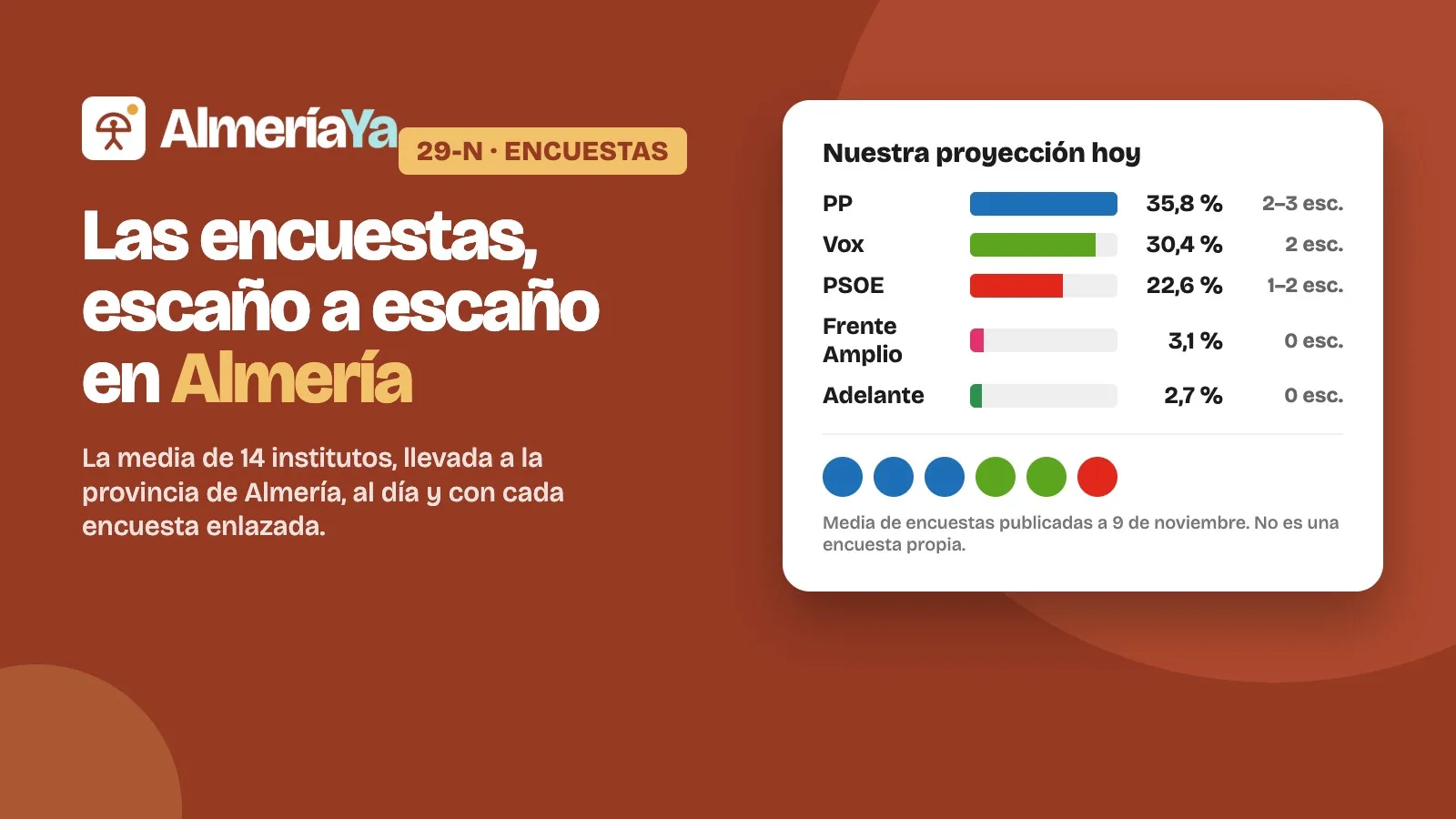
AlmeríaYa's general election special gathers all published polls and calculates the province's 6 seats. Today it shows Vox second, ahead of the PSOE. We explain what the section offers, how it is calculated and how to follow it.
Redacción
·
Photo: AlmeríaYa
Almería is the Andalusian province where Vox is strongest, and the 29-N polls confirm it. To see it in numbers, the AlmeríaYa general election special has a section, «What the polls say», that gathers all the published ones and takes them to the 6 Almería seats.
We tell you what's in it, how the count is done and how to follow it until the last allowed day.
The start of the section, with the date of the last revision. Photo: AlmeríaYa
At a glance
What the section has
—Our projection: vote and seats, with a range.
—The national average the count starts from.
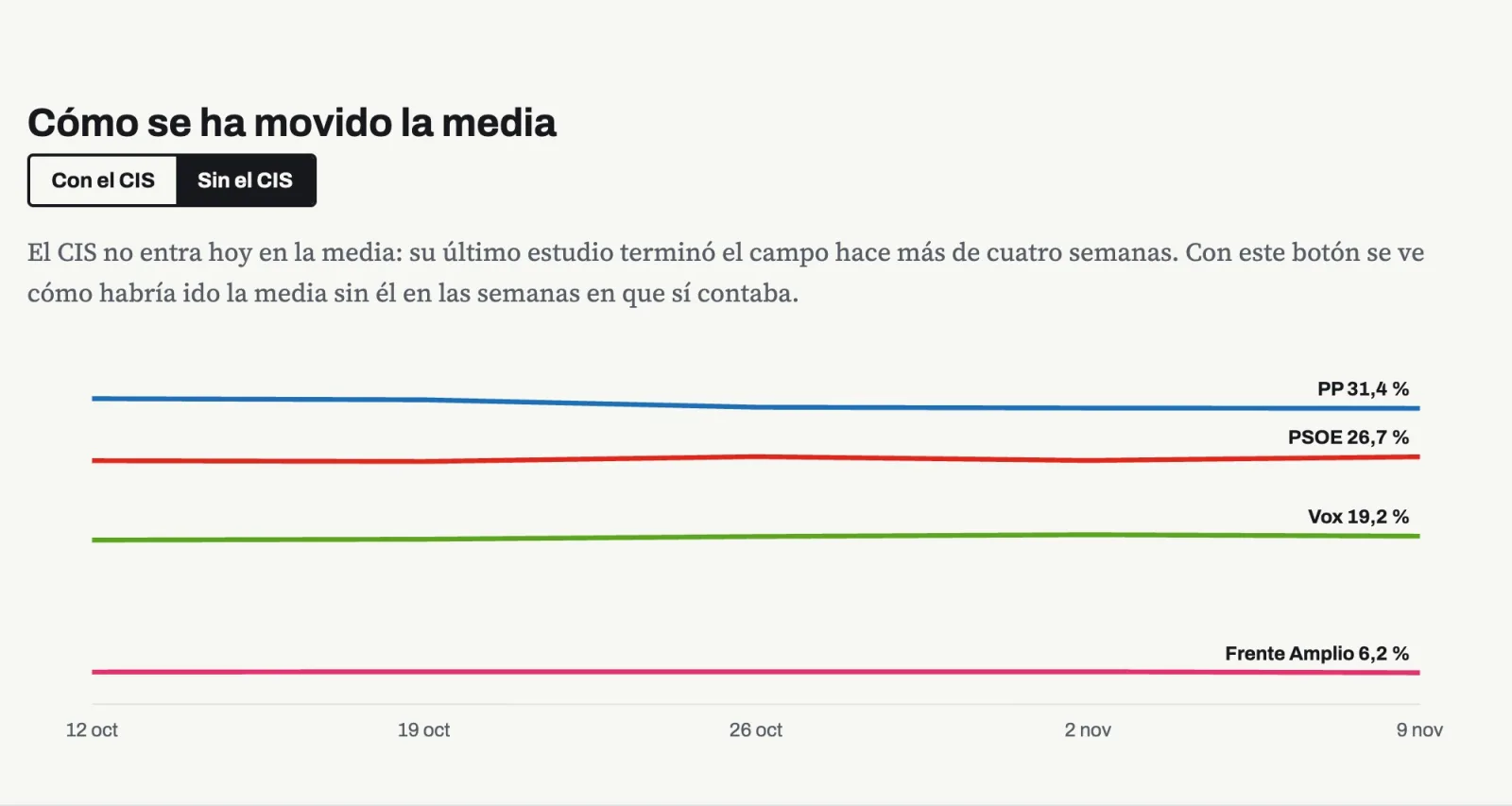
—Its weekly evolution, with and without the CIS.
—The figures the institutes give for Andalusia.
—The simulator to do your own count.
—All the polls, linked.
—The method, in case you want to check it.
What it says today for Almería
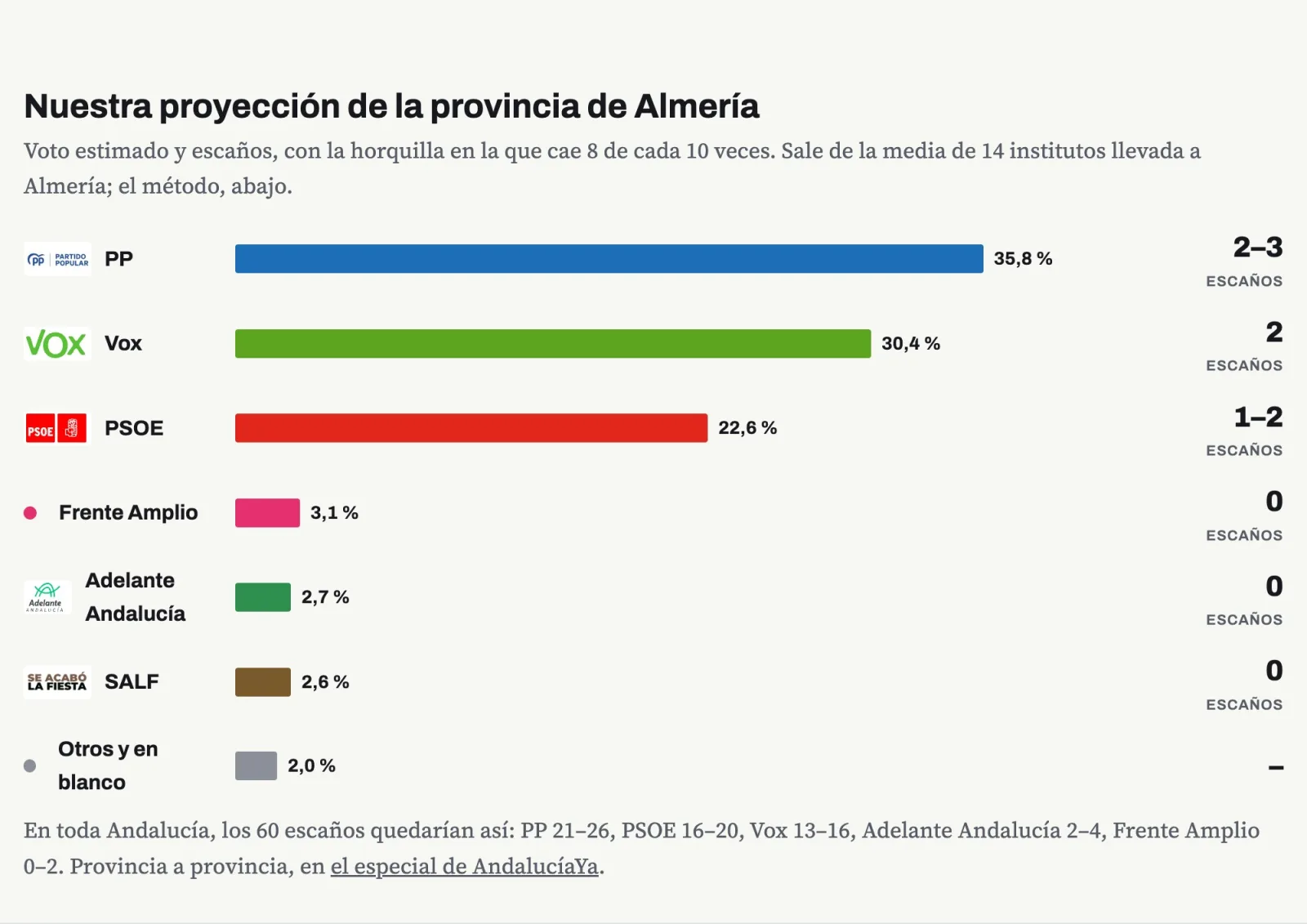
This is how the projection for the province of Almería looks in the special, with figures from November 9. Photo: AlmeríaYa
With the polls revised on November 9, the PP would be the most voted in the province with 35.8% and 3 seats, the same as in 2023. Vox would rise to 30.4% (it had 21.3% in 2023) and would go from 1 to 2 deputies. The PSOE, with 22.6%, would drop from 2 to 1.
Watch out for the sixth seat: today it is the PP's, but the next in line is the PSOE and very little separates them. That is why the ranges say PP from 2 to 3 and PSOE from 1 to 2.
The distribution in the province of Almería, then and now
Partido
Votos en 2023
Escaños en 2023
Proyección hoy
Escaños hoy (horquilla)
PP
40,9 %
3
35,8 %
3 (2 a 3)
Vox
21,3 %
1
30,4 %
2 (2)
PSOE
29,0 %
2
22,6 %
1 (1 a 2)
Frente Amplio (Sumar en 2023)
6,7 %
0
3,1 %
0 (0)
Adelante Andalucía
–
0
2,7 %
0 (0)
SALF
–
0
2,6 %
0 (0)
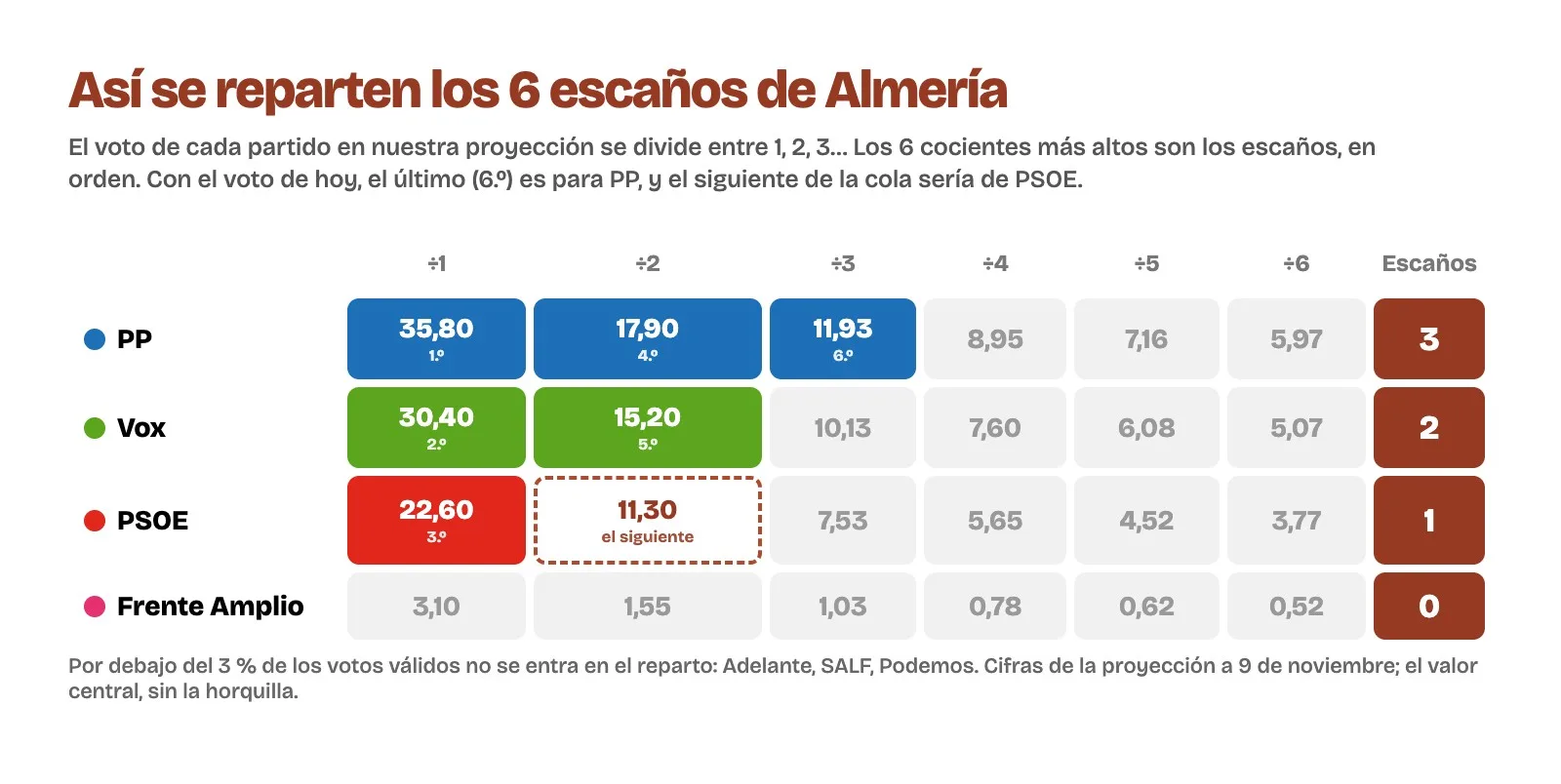
The distribution with the projected vote: in colour, the quotients that win a seat. Photo: AlmeríaYa
To distribute the 6 seats a calculator is enough: divide each party's vote by 1, 2, 3 and so on, and order all the results. The first 6 are deputies. The one that closes the list in Almería is the PP's, with 11.93; the first left out, the PSOE's, with 11.30. With 0.63 points of difference, it is a seat in dispute.
What is behind each number
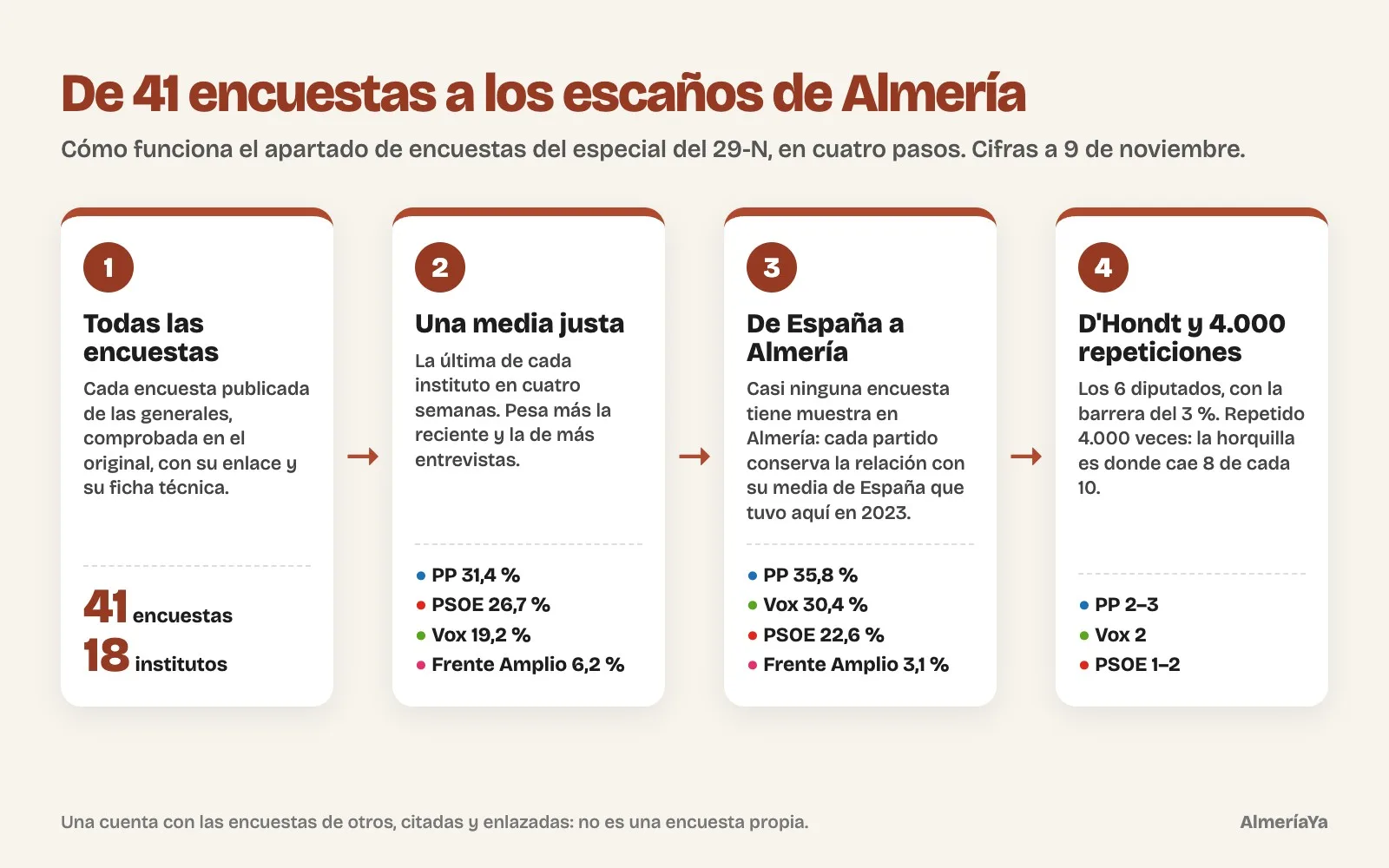
Four steps and none of them secret. Photo: AlmeríaYa
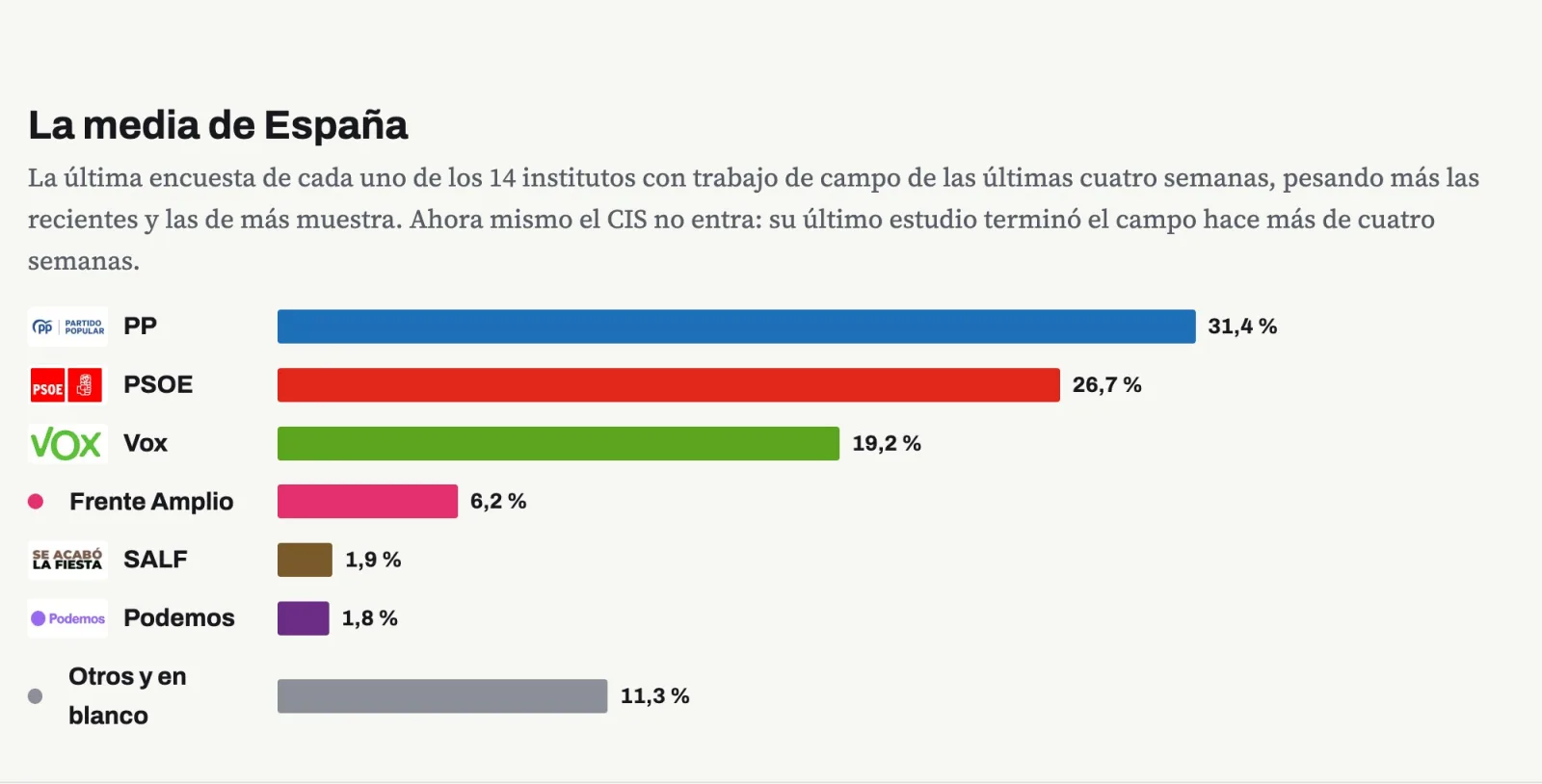
Behind each bar there is a count that can be repeated with pencil and paper, and that is explained on the page itself. It starts with the 41 polls published since October 1, from 18 different institutes. Of these, the last one from each institute is kept if it is less than four weeks old, and they are averaged giving more weight to recent ones and to large samples: today there are 14.
The jump to Almería is the delicate part. What we know for certain is how Almería voted in 2023 compared with Spain, and that is what we use. Then the PP added 40.9% in the province, the PSOE 29.0% and Vox 21.3%, against 33.1%, 31.7% and 12.4% nationally. Multiplying by that relationship gives the provincial estimate. Parties without their own result in 2023 use another reference: Podemos and SALF, the 2024 European elections; Adelante Andalucía, the 2026 regional elections.
And the last step: the distribution of the 6 seats is done with D'Hondt and the 3% threshold. As no average is exact, we repeat the count 4,000 times with random errors similar to the real ones: the result falls within the range in 8 out of 10.
The projection for the province of Almería comes from this average. Photo: AlmeríaYa
Why a button for the CIS?
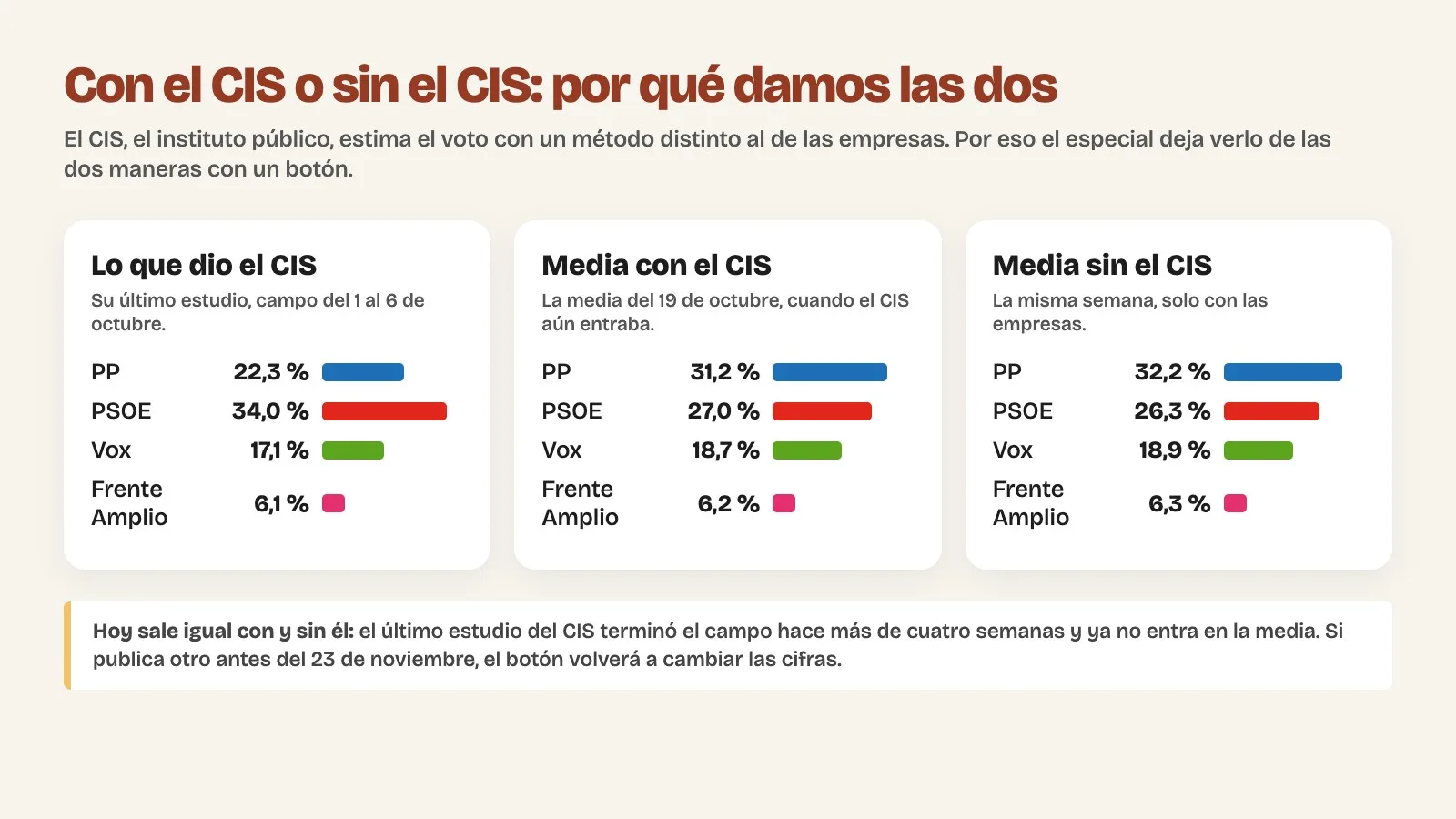
The CIS against the average, with and without it. Photo: AlmeríaYa
A question we have been asked: why is there a CIS button? Because the Centro de Investigaciones Sociológicas, the public institute, does not estimate the same as the companies, and its figures depart from the rest. Its latest study, with interviews from October 1 to 6, gave 34.0% to the PSOE and 22.3% to the PP.
Including it in the average or not changes the result, so the reader chooses. An example of when it counted: on October 19, the average with the CIS gave the PSOE 27.0%; without it, 26.3%.
Today it makes no difference to press one or the other for the projection: the CIS study is already more than four weeks old and does not enter. You will see it explained next to the button, which meanwhile is in the average chart.
The average chart in the AlmeríaYa special, with the CIS switch. Photo: AlmeríaYa
Do your own count
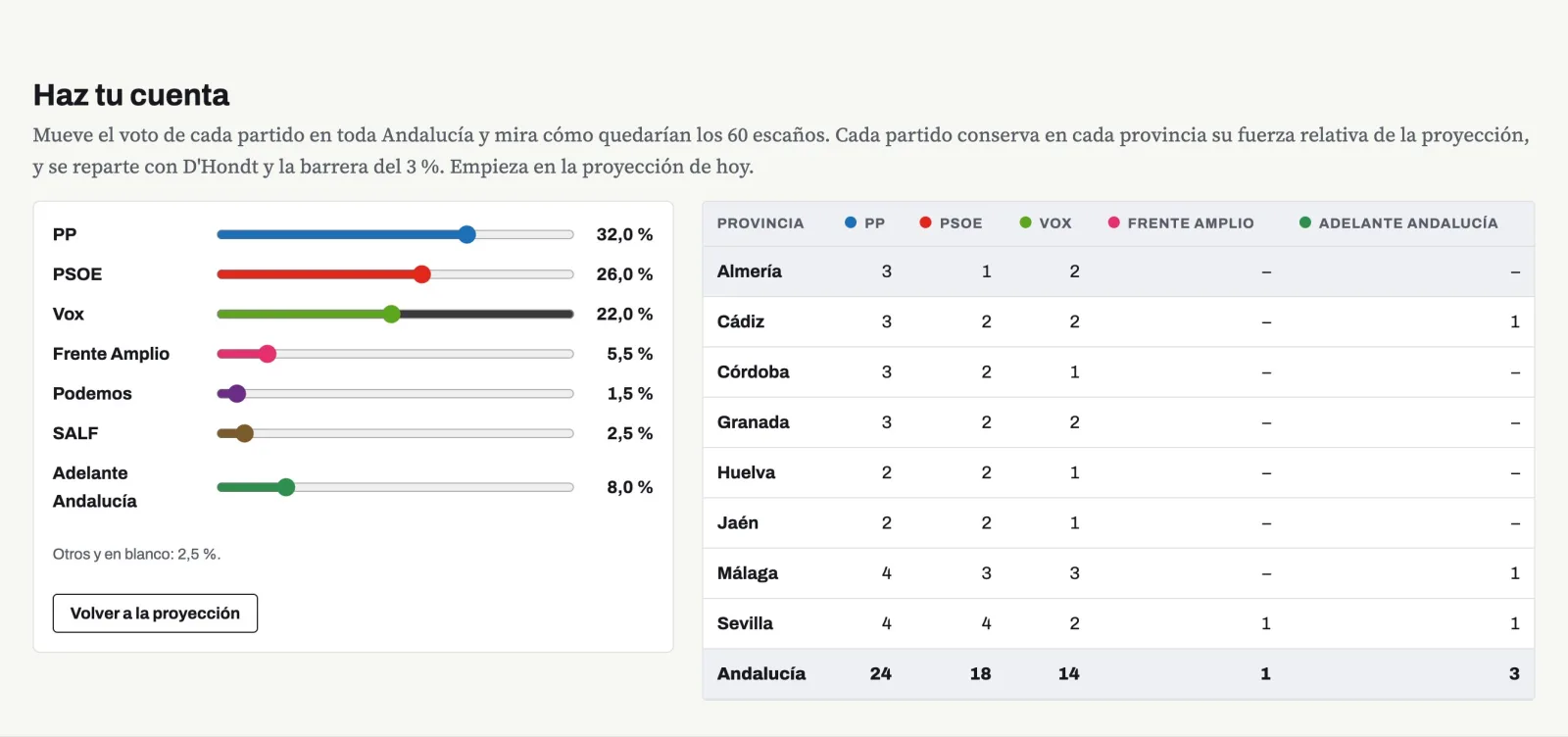
The simulator of the AlmeríaYa special, at its starting point. Photo: AlmeríaYa
With «Do your count» you can check how fragile the sixth seat in Almería is: raise the PSOE a couple of points and look at the first row of the table. Each party keeps its relative strength in each province, so the change is distributed as it would in reality.
The section also includes, untouched, the polls that estimate Almería seats. Sigma Dos, for El Mundo (fieldwork until October 14), gave the same distribution as our count: PP 3, Vox 2 and PSOE 1.
All the polls, with their link
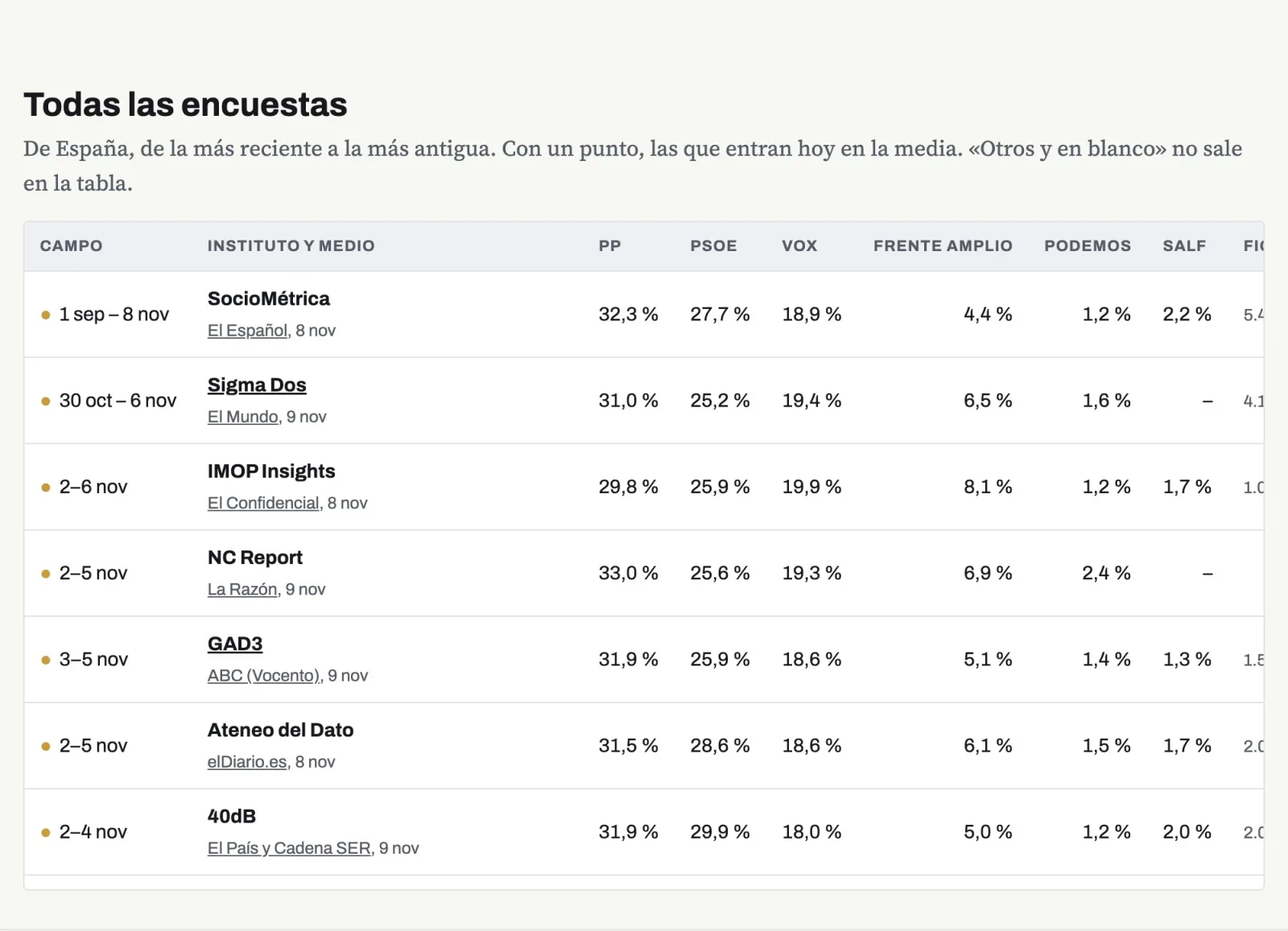
The table of all the polls: a dot marks those that count today. Photo: AlmeríaYa
If you wonder where each figure comes from, the answer is in the final table. Each poll carries the institute, the outlet and its link, the interview dates and the technical sheet. The dot on the left marks those that are part of the average today.
How to use it every day
We designed it to be checked daily without wasting time. You open the section, look at the update date and go straight to the projection. If you want to know why something has changed, go down to the table: the new poll will be at the very top and marked with a dot.
The figures change little from one day to another, and that is a good sign: an average like this does not get dragged along by a single striking poll. When it really moves, it shows in the chart for several weeks in a row.
November 23 will be the last day with new data. From the 24th to the 28th electoral law does not allow polls to be published, so the section will stay as it is that day, with a notice explaining it.